RHOMBUS · Offline mission platform

Deployment is day zero. Rhombus is built for every day after.

Rhombus is a portable mission platform from Rhombus Security: mission software in a rugged kit, starting with a full defensive cyber stack, run from one console with no internet connection. Deploy it, prove it works, patch it, audit it and reset it in the field, the same way on every kit.

Built for

  • Cyber Protection Teams
  • Defensive cyber operations (DCO)
  • Forward-deployed missions
  • Incident response
  • Program offices

Illustrative console. Scenario names and timings are representative.

internet connections required
0
console for the whole lifecycle
1
mission capabilities, monitoring to training
10
lifecycle stages, deploy to reset
5
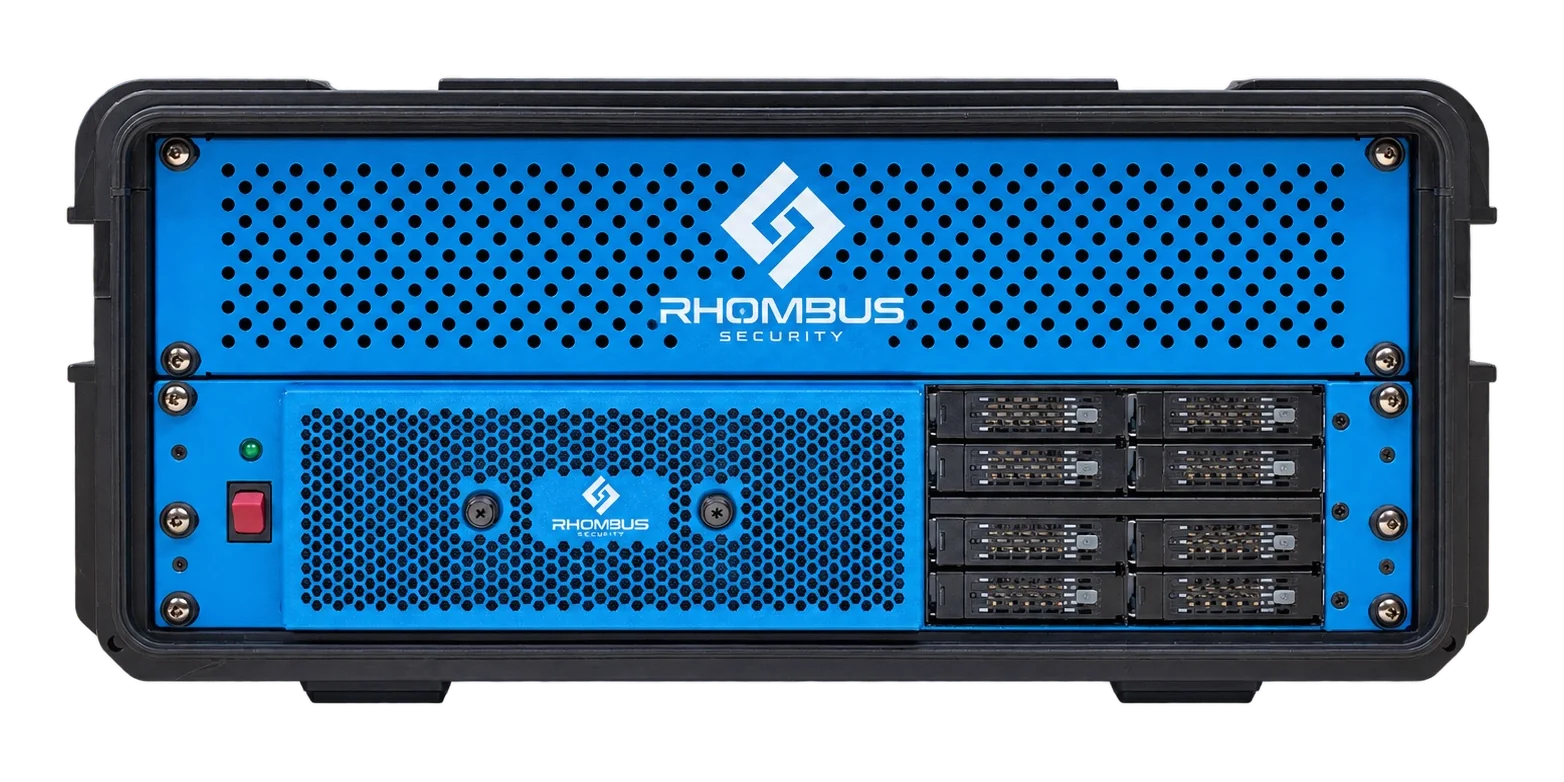
Front of a Rhombus Edge kit: a 4U rugged travel case with a Rhombus Security panel above a compute server and eight hot-swap drive bays
Rhombus EdgeThe whole platform in a 4U rugged travel case, sized for airline overhead bins.Specifications →

The shift

A fly-away kit is the delivery vehicle. Rhombus is the mission capability.

A fly-away kit is the portable, self-contained equipment a team carries to the mission. Most are finished when they're racked and powered on. Every patch, reset and rebuild after that means a vendor engineer or a trip back to the depot. Rhombus treats the kit as one piece of a platform that you operate: repeatable, auditable and sustained in the field.

Day 0 to day 90

Same mission. Two kits. Scroll to see which one is still ready.

  1. Day 0 · Deploy

    Mission packages deploy from one console, built from version-controlled code.

    Without a sustainment platform: Hand-configured on site from a checklist.

    Rhombus: known-goodWithout: Configured by hand

  2. Day 1 · Validate

    Every critical service and sensor checked. Acceptance report exported.

    Without a sustainment platform: Powered on. Nobody has proven the sensors see traffic.

    Rhombus: known-goodWithout: Unverified

  3. Day 30 · Sustain

    Signed bundle applied offline from USB. Rollback point kept.

    Without a sustainment platform: Patches need reach-back or a site visit.

    Rhombus: known-goodWithout: Falling behind

  4. Day 90 · Prove

    STIG evidence exported on demand for the assessor.

    Without a sustainment platform: Evidence assembled by hand, if it exists.

    Rhombus: known-goodWithout: Out of date

  5. Next mission · Reset

    Mission services rebuilt to the delivered baseline, ready for the next team.

    Without a sustainment platform: Re-image by hand, or ship it back to the depot.

    Rhombus: known-goodWithout: Back to the depot

The Rhombus lifecycle

One console runs the whole mission lifecycle.

The Rhombus Application Control Console (RACC) runs the full lifecycle in the field with no reach-back: deploy, validate, operate, sustain, reset, and repeat for the next mission.

  1. 01

    Deploy

    Mission packages, not integration projects

    Pick a scenario, such as incident response, malware lab or training range, and deploy the whole package from a single console action. Dependencies are ordered automatically, deployments run in parallel, and you watch live progress with an ETA.

  2. 02

    Validate

    Proof it works, not just that it powered on

    Built-in validation checks core services, identity, sensors, threat intel and the console itself. Failed critical checks self-heal by re-running their install. Results export as an acceptance report.

  3. 03

    Operate

    One console, every role

    Analysts, administrators and platform admins each see what their role allows, signed in through single sign-on. Every deploy, reset and destroy is written to the audit trail. Health, capture ingest and GPU dashboards are always one tab away.

  4. 04

    Sustain

    Patched and current, air-gapped

    Nightly update scans on every VM. Signed, checksummed sustainment bundles are applied from upload or USB, and they apply atomically, with a rollback point kept for the update repositories. STIG scans run on demand, with evidence ready for your assessor.

  5. 05

    Reset

    Back to known-good between missions

    Factory reset rebuilds mission services to the delivered baseline as a single job, without touching core infrastructure. The next team starts clean.

  6. ↻ 01

    Repeat

    Every kit. Every mission. The same known-good state.

    The cycle closes on itself. Each team inherits a kit rebuilt to its delivered, known-good baseline, and kits on the same release share the same baseline. No depot trip in between.

    Inside the platform →

The Rhombus family

One platform. The form factor your mission needs.

Fly-away applianceAvailable

Rhombus Edge

The complete Rhombus platform in a single ruggedized, transportable system. You get sensors, analytics, threat intel, a malware lab, deception and a training range, all run from one console with no network connection.

Software platformAvailable

Rhombus Core

The Rhombus Application Control Console (RACC) and the infrastructure-as-code foundation beneath it. It deploys, validates, patches, audits and resets the full stack, independent of the underlying hardware and hypervisor.

Malware & reverse engineeringAvailable

Rhombus Analyze

An isolated malware analysis and reverse-engineering lab you deploy as a mission package on Edge: automated triage, static and dynamic analysis, and analyst workstations.

Sustainment subscriptionAvailable

Rhombus Support

Keeps a fielded kit current and supported without sending it back to a depot. You get signed quarterly sustainment bundles, a dedicated help desk with SLAs, and tiered engineering support.

On-kit AI assistantAvailable

Rhombus AI

An analyst assistant that runs on the kit's own GPU, with open-weight models and a documentation library that both live on the kit. Analysts sign in with their kit identity and get chat, answers from kit documentation and scripting help, with no internet connection.

Fleet managementAvailable

Rhombus Station

Turns one Rhombus console into a command point for many deployed kits. Enroll remote sites, see their health at a glance, and deploy or tear down mission packages across the fleet from one place.

Built for accreditation

Evidence your assessor can use, not just claims on a spec sheet.

Rhombus is designed to support your ATO and RMF package. Where something isn't protected, we say so.

Security & compliance posture
  • Hardened to DISA STIG, with every deviation documented and justified
  • On-demand compliance scans export ARF, HTML and STIG Viewer import files
  • FIPS mode on the host and every hardened guest
  • Full-disk encryption at rest (LUKS2) on current-generation kits
  • Role-based access, SSO and a full audit trail for every lifecycle action
  • Passive capture with no change to the production data path

Training

Train on the kit you fight with.

The same system your team deploys carries its own scored range: vulnerable targets, PCAP replay, a live Active Directory purple-team environment and CTF challenges. Instructor-led courses take operators from power-on to hunt.

Courses & services

5 days · instructor-led

Rhombus FAK 101

Kit operations, network security monitoring, incident response and forensics, and offensive validation, followed by a full-day capture-the-flag exercise.

1–2 days · purple team

AD Detection Range

Run → Detect → Validate → Hunt against a live Active Directory forest.

Questions

What people ask first.

Straight answers. If yours isn't here, ask us in a briefing.

Ask the team

What is Rhombus?

Rhombus is a portable mission platform from Rhombus Security. It deploys, patches and resets mission software on a rugged, transportable kit from one console, without an internet connection. Its most complete portfolio is defensive cyber: network sensors, analytics, threat intelligence, a malware analysis lab, cyber deception and a training range.

What is a fly-away kit?

A fly-away kit is a portable, self-contained set of computing and network equipment that a team carries to a site, such as a forward location, an incident or an isolated network, instead of relying on remote infrastructure. Rhombus Edge is Rhombus delivered as a fly-away kit, in a 4U rugged travel case.

How is Rhombus different from other deployable cyber kits?

Most deployable kits focus on the hardware and the initial setup. Rhombus focuses on every day after deployment: it validates that services and sensors are working, applies signed updates offline with rollback, produces DISA STIG scan evidence on demand, and resets mission services to a known-good baseline between missions.

Does Rhombus need an internet connection?

No. Rhombus is designed to operate fully air-gapped. Deployment, validation, patching, compliance scans and resets all run on the kit. Repositories can be synced when a connection is approved, but nothing requires one.

How is Rhombus updated without internet access?

Updates arrive as signed, checksummed sustainment bundles that operators upload through the console or load from USB. Each bundle’s signature is verified before anything is applied, and a rollback point is kept for the kit’s update repositories.

Is Rhombus hardened to DISA STIG?

On current-generation kits, the host and the hardened guest images are hardened to the DISA STIG (the U.S. Defense Information Systems Agency Security Technical Implementation Guide), and every deviation is documented with its rationale. The console runs compliance scans on demand and exports ARF, HTML and STIG Viewer import files to support your accreditation. Scan results support an accreditation; they are not a certification.

Who uses Rhombus?

Rhombus is built for cyber protection teams, defensive cyber operations units, incident responders, training units and the program offices that equip them, especially teams that work in disconnected, contested or air-gapped environments.

How do I see Rhombus or buy it?

Request a briefing from the contact page. The team runs a live, end-to-end demonstration on real hardware, fully offline, and works with program offices and contracting officers on the purchase path.


See the full lifecycle in 90 minutes.

Our end-to-end briefing takes a Rhombus kit from power-on through detection, investigation, evidence export and reset to baseline. It runs on real hardware, fully offline.

Request a briefingOverview PDF
Esc

↑↓ moveEnter openCtrl K anywhere